A complete hospital EHR,
built for students, not patients.
target 88–92%
3 mL neb · q4hDue 14:00
40 mg IV · q12h20:00
500 mg PO · daily09:00
Titrate to SpO₂ 88–92%Active
Expiratory wheeze · RLL diminished›
SpO₂ 89% on ambulation›
DuoNeb given · response pending›
Night shift · N. Okafor, RN›
| Vital sign | 13:00 NOW |
12:00 | 11:00 | 10:00 | 09:00 | 08:00 | 07:00 | 06:00 | 05:00 | 04:00 | 03:00 | 02:00 |
|---|---|---|---|---|---|---|---|---|---|---|---|---|
| Heart rate bpm | 96 | 98 | 101 | 104 | 102 | 99 | 97 | 96 | 99 | 103 | 101 | 98 |
| Blood pressure mmHg | 142/84 | 140/82 | 138/80 | 144/86 | 139/81 | 136/80 | 134/78 | 132/78 | 135/80 | 138/82 | 136/80 | 132/76 |
| Respirations /min | 22 | 24 | 26 | 28 | 26 | 24 | 22 | 22 | 24 | 24 | 22 | 22 |
| SpO₂ % | 93 | 89* | 92 | 91 | 88 | 87 | 90 | 91 | 92 | 92 | 93 | 92 |
| O₂ flow L/min | 2 | 2 | 2 | 2 | 2 | 2 | 2 | 2 | 2 | 2 | 2 | 2 |
| Temperature °C | 37.8 | 37.7 | 37.8 | 37.9 | 37.8 | 37.7 | 37.6 | 37.6 | 37.5 | 37.4 | 37.4 | 37.3 |
| Pain 0–10 | 2 | 2 | 3 | 3 | 2 | 2 | 2 | 1 | 1 | 1 | 0 | 0 |
| Respiratory effort | Mild | Mild | Moderate | Moderate | Moderate | Mild | Mild | Unlabored | Unlabored | Unlabored | Unlabored | Unlabored |
| Dyspnea 0–10 | 3 | 5* | 4 | 4 | 5 | 4 | 3 | 3 | 2 | 2 | 2 | 2 |
| Level of consciousness | Alert | Alert | Alert | Alert | Alert | Alert | Alert | Alert | Alert | Alert | Alert | Alert |
| Mobility | Standby | Ambulated* | Rest | Rest | Chair | Standby | Bedrest | Bedrest | Bedrest | Bedrest | Bedrest | Bedrest |
| O₂ device | Nasal cannula | Nasal cannula | Nasal cannula | Nasal cannula | Nasal cannula | Nasal cannula | Nasal cannula | Nasal cannula | Nasal cannula | Nasal cannula | Nasal cannula | Nasal cannula |
| Breath sounds | Exp wheeze | Exp wheeze | Dim. bases | Dim. bases | Dim. bases | Dim. bases | Dim. bases | Dim. bases | Dim. bases | Dim. bases | Dim. bases | Dim. bases |
| Cough | Productive | Productive | Productive | Productive | Dry | Dry | Dry | Dry | Dry | Dry | Dry | Dry |
| Sputum | Scant white | Scant white | Scant white | None | None | None | None | None | None | None | None | None |
| Position | High Fowler | Chair | High Fowler | High Fowler | High Fowler | High Fowler | Semi-Fowler | Semi-Fowler | Semi-Fowler | Semi-Fowler | Semi-Fowler | Semi-Fowler |
| Activity tolerance | Fair | Poor* | Fair | Fair | Fair | Fair | Fair | Fair | Fair | Fair | Fair | Fair |
| Medication order | Last dose | Future | Now | Recent administrations | |||||||
|---|---|---|---|---|---|---|---|---|---|---|---|
| 20:00 | 18:00 | 16:00 | 15:00 | 14:00 | 13:00 | 12:00 | 10:00 | 09:00 | 08:00 | ||
| Ipratropium–albuterol 0.5/2.5 mg3 mL neb · inhaled · q4h scheduled | 10:03 N. Okafor | Due | Due now | Given | |||||||
| Methylprednisolone 40 mgIV push · q12h scheduled | 08:08 N. Okafor | Due | Given | ||||||||
| Enoxaparin 40 mgSubcutaneous · daily | 09:01 N. Okafor | Given | |||||||||
| Azithromycin 500 mgPO · daily · with food | 09:04 N. Okafor | Given | |||||||||
| Salbutamol 100 mcg2 puffs inhaled · q2h PRN dyspnea | 12:24 N. Okafor | Given | |||||||||
| Acetaminophen 650 mgPO · q6h PRN pain or fever | — | PRN | |||||||||
| Nicotine patch 14 mg/24 hTransdermal · daily | 09:10 N. Okafor | Given | |||||||||
| Pantoprazole 40 mgPO · daily before breakfast | 08:02 N. Okafor | Given | |||||||||
| Sennosides 17.2 mgPO · at bedtime · bowel protocol | 20:11 A. Singh | Due | |||||||||
| Sodium chloride 0.9% flush10 mL IV · q8h and PRN | 12:06 N. Okafor | Due | Given | ||||||||
| Budesonide–formoterol 160/4.5 mcg2 puffs inhaled · BID scheduled | 08:12 N. Okafor | Due | Given | ||||||||
| Guaifenesin 200 mgPO · q4h PRN productive cough | — | PRN | |||||||||
Introducing Aurora.
Practice a complete shift before a real patient is waiting.
Aurora combines a synthetic patient, a credible hospital chart, and a guided case so students can move from handoff to evidence-backed feedback in one continuous workflow.
Clinical judgment is taught. Charting should be too.
Anything you'd chart on a real shift,
you can chart here.
Time columns, med passes, entry states, abnormal flags — the flowsheet behaves like the ones on the floor, so what you practice is what transfers.
Take the handoff
Every case starts the way a shift does — an SBAR report from the off-going nurse, with the details you'll need buried in the details you won't.
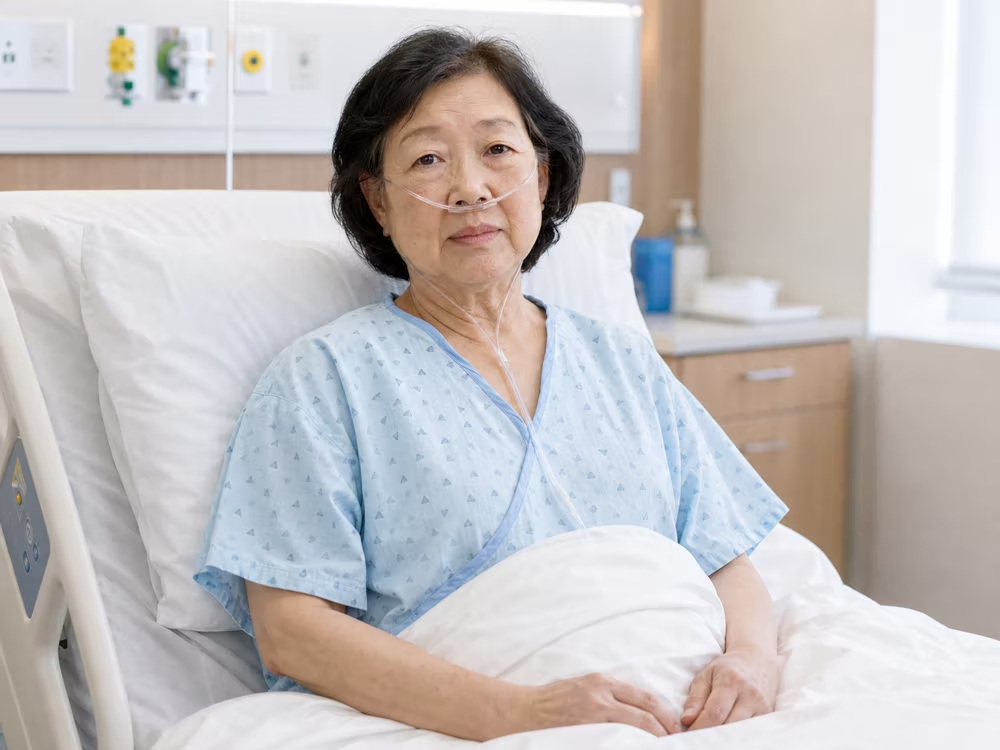
Case image · Margaret Chen
Expiratory wheeze · diminished air entry
Assess at the bedside
Look, listen, and press. The interactive patient reveals findings the chart never will — and what you find is what you chart.
| Criterion | 07:42 You | 06:00 | 02:00 |
|---|---|---|---|
| Breath sounds | Wheeze · L base | Dim. bases | Dim. bases |
| Work of breathing | Moderate ↑ | Increased | Mild |
| Cough | Productive | Dry | — |
| SpO₂ / O₂ | 91% · 2 L NC | 88% · 2 L | 92% · 2 L |
| Sputum | Scant · white | — | — |
Chart your findings
Document independently in a real flowsheet — your entries in your column, in your own words, timestamped like the floor expects.
Scored against what the patient actually revealed.
Every case ships with expected findings. When you finish, Aurora compares your chart against them — by system, by finding, by timestamp. See how scoring works
Guidance that knows where you are
in the case.
Aurora isn't a sandbox with a worksheet next to it. Each objective knows what you've reviewed, what the patient showed you, and what still needs to be charted.
Assess Ms. Chen's breathing and chart what you find
You've seen the trend and heard her lungs. Document your own assessment before the 08:00 med pass.
Where mistakes cost nothing.
The whole point of a simulated chart is that you can get it wrong. Aurora is built so that getting it wrong is useful.
Every patient is fiction
Cases are authored, not imported. No real records, no real people — just clinically credible ones.
07:42 charted RR 22
07:44 auscultated L base
Every action becomes feedback
What you opened, what you charted, and when — captured so your debrief is about what you actually did.
Reset and run it again
Wipe the chart, keep the lesson. Repeat a case until the workflow is muscle memory, not luck.
Evidence your instructor
can actually grade with.
Every completed case produces a scored report — findings documented, findings missed, and the timeline of how the student worked.
Margaret Chen · COPD exacerbation
R. Lopez · NRS-302 · Attempt 2 · Jul 23
completed
The chart stays clinical.
The coaching gets personal.
Aurora scores each case with educator-authored rules, then uses AI to turn that evidence into clear feedback: what you did well, what to revisit, and what to try next.
You recognized Margaret’s increased work of breathing and documented the change before administering the scheduled DuoNeb.
Connect the post-treatment breath sounds and activity SpO₂ to the MAR event. That closes the loop between intervention and response.
What finding would make you escalate to respiratory therapy rather than continue routine reassessment?
Fiction, by design.
Aurora rehearses real clinical workflows without ever touching real clinical data.
Synthetic records only. Every patient, lab value, and med order is authored for teaching. Nothing is derived from real charts.
No PHI, ever. There is nothing to breach — no real names, no real identifiers, no compliance surface for your program to carry.
your scores → you + instructor
everyone else → nothing
Your work stays yours. Attempts and scores are visible to you and the instructor you share them with. Nobody else.
Runs in the browser. No install, no VPN, no lab machines. A case is a link — it works in the library, the sim lab, or at home.